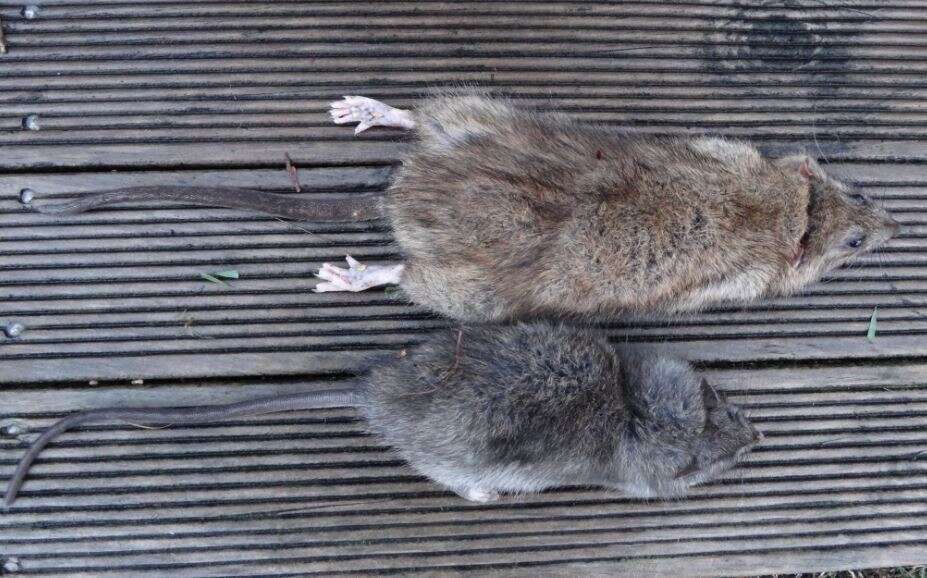
Calling someone a rat is usually derogatory all over the world. The rat pack in this case study involves two species of what we commonly recognise as rats - the black rat and the brown rat, Rattus rattus and Rattus norvegicus.
The Misplaced


Appearance
| R.rattus Black rat | R. norvegicus Brown rat |
|
|---|---|---|
| Mass (g) | 120 - 200 | 150 - 300 |
| Length (mm) | 120 - 180 | Up to 400 |
| Coat colour | Back - brown Belly | Back - brown Belly - pale grey |
| Other | The tail is longer than the head-body length Large hairless ears | The tail is shorter than the head-body length Small ears |

Special adaptations:
- robust jaw and incisors for dealing with varied diet
Breeding
| R.rattus | R. norvegicus | |
|---|---|---|
| Average number of offspring per litter | 5 - 8 | 6 - 11 |
| Average gestation period (days) | 20 - 23 | 21 - 24 |
| Average time to sexual maturity (days) | 120 | 40 - 70 |
| Lifespan (years) | 2 - 4 | 3 |
Stage of development from newborn to adult
| Stage | Body shape | Age (Days) | Comment |
|---|---|---|---|
| Neonate |  | 1 - 14 | hairless, eyes not yet open |
| Weanling |  | 14 - 28 | learning to eat solids, descreasing depenency on mother |
| Adolescent |  | 28 - 60 | independent of mother, exploring environment, learning survival skills |
| Adult |  | 60 - | capable of breeding |


Ecology
Habitat
Black rats can utilise a wide range of habitats They do have a preference for drier habitats, and avoid immersion in water.
Brown rats are also widespread, but do have a preference for wetlands. They are strong swimmers.
Diet
Both species are omnivorous and adaptive/opportunistic which contributes to their geographical spread. They consume
- vegetation particularly fruit, nuts and grains
- birds and eggs
- turtle hatchlings
- invertebrates (beetles, spiders, flies)
- fish
- shellfish
- manufactured food in built-up areas (think New York pizza rats)
Predators
These rat species are eaten by

- cats and dogs
- foxes
- lynxes
- mongooses
- stoats, ferrets, polecats and weasels
- birds of prey such as owls and eagles
- snakes
The Displaced
Because of their near global presence and flexible eating habits, it is difficult to pinpoint the exact species displaced by invasions by rats. They disrupt agriculture by ruining crops. They disrupt ecosystems through increasing scarcity of and competition for food resources as they can increase their population size so rapidly. Also they prey on some species to the point of eradication e.g. bird populations on islands drop when rats invade.
Both species are also know to be disease vectors. Associated serious diseases include leptospirosis, hantavirus pulmonary syndrome, murine typhus, and bubonic plague.
The Consequences
Where is the invasion?
R. rattus native to India; R. norvegicus native to northern China
Current distributions


Case studies snippets
Since 2010 there have been over 30 successful rat eradications in small, uninhabited islands right across the Pacific region. Among those efforts was the 2011 removal of rats from the uninhabited Palmyra Atoll between Hawaii and American Samoa, which resulted in a 5,000 percent increase in native plant seedlings, the recovery of its coral reefs and substantial increases in two previously undocumented crab species.
https://www.aljazeera.com/opinions/2022/10/19/the-pacifics-stark-future-its-either-rats-or-reefs
A 2018 study in the Chagos Archipelago in the Indian Ocean found rat-free islands have significantly more seabirds (sometimes 10 times as many) as rat-occupied islands and thus more seabird guano that both enriches their soils and runs off onto the coral reefs.
This natural fertilization seems to make the coral more resilient to climate change and also attracts more herbivores, including parrotfish (family Scaridae).
This video explores the reproductive capacity of rats, a trait the makes them such successful invaders
Eradication strategies

Besides the extensive damage to crops, invasion by rats has directly caused or contributed to the extinction of many species of wildlife including birds, small mammals, reptiles, invertebrates and plants, especially on islands. Invasive rats are likely to be more successful on oceanic islands mainly due to the scarcity of other small rodents able to compete with them, in contrast to very large near-shore islands or continents with a more diverse range of functionally equivalent competitors. Also having a smallish fixed area to work through makes successful elimination easier to carry out. The largest island so far on which eradication has been successful is MacQuarie Island between Australia and Antarctica.
On a global basis, using poisons is by far the most common method of dealing with rat invasions.

 Rat kings - a group of rats bound together by an entanglement of tails. Some maintain that they are manufactured by people seeking publicity. Others maintain that this is a natural, although rare, phenomenon. A number of specimens are on exhibit in natural history museums today, some verified through X-ray images revealing entangled bones and genuine rat king formations.
Dig Deeper
- Rattus rattus
- Rattus norvegicus
- Rat killers in paradise: An eradication program remakes a tropical atoll
- Rating the rat: Global patterns and research priorities in impacts and management of rodent pest
- Rat eradication restores nutrient subsidies from seabirds across terrestrial and marine ecosystems
- Rodenticide - an overview